
NeuTigers cardiometabolic portfolio
EVIDENCE
Five proof points. One transparent evidence hierarchy.
NeuTigers combines a multinational cardiometabolic knowledge base, published model research and a completed consumer-wearable proof of concept. Each result is labeled by context so research evidence is not mistaken for a consumer product claim.
Review the proof ↓THE EVIDENCE AT A GLANCE
The facts to remember.
Portfolio figures reflect NeuTigers research records as of August 2026. Published performance is tied to one identified analysis and is not generalized to the planned wellness product.
Completed or initiated across three continents
Public SweetDeep preprint
Reported before confidence-based abstention
Completed with Samsung
Supporting detail: Cardiometabolic knowledge base
WHAT EACH LEVEL PROVES
From foundational data to product readiness.
No single number carries the full story. The strength comes from the relationship among the research portfolio, model evaluation and partner implementation.
RESEARCH FOUNDATION
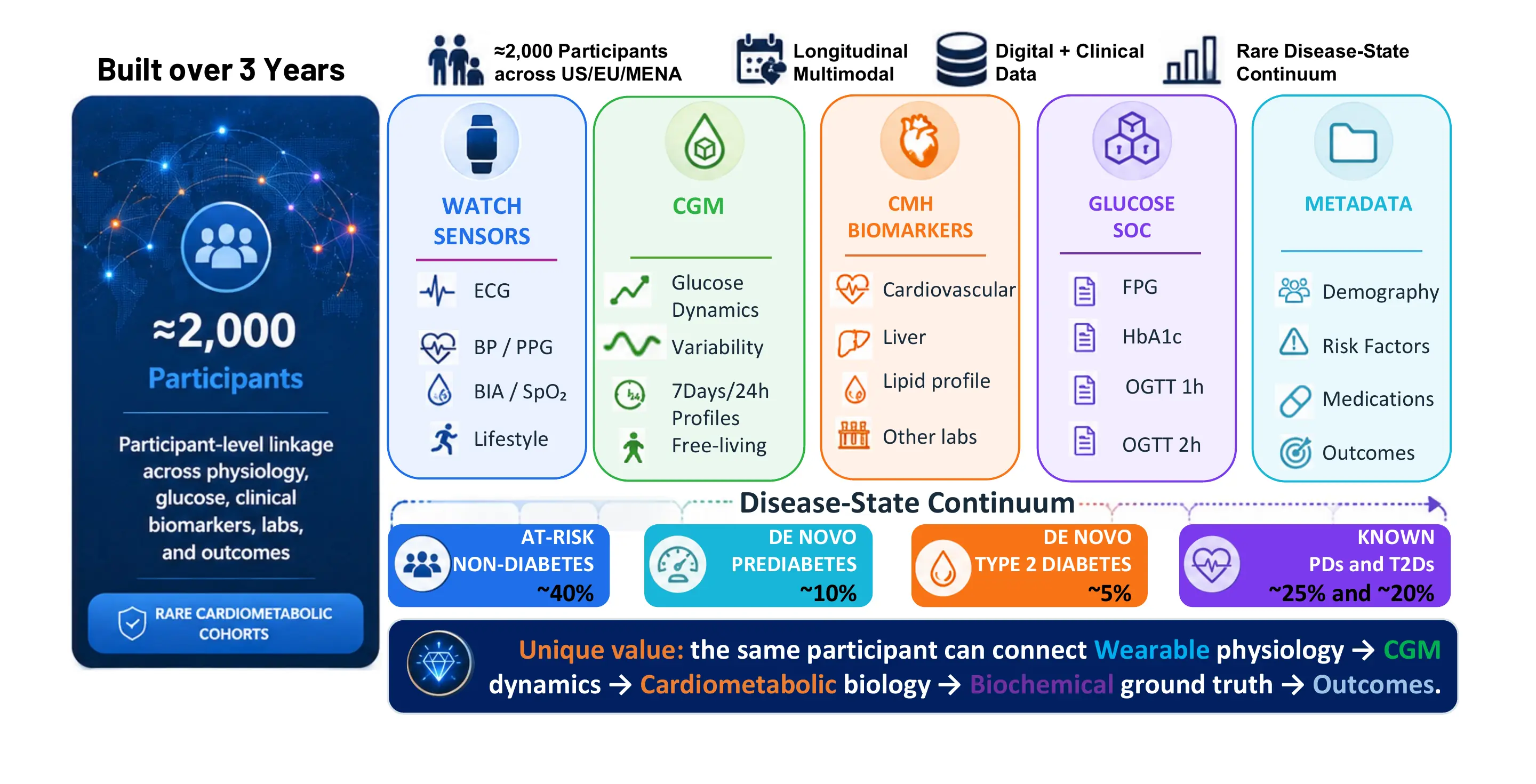
Approximately 2,000 participants across the U.S., Europe and MENA
Participant-level linkage connects wearable physiology with CGM dynamics, cardiometabolic biomarkers, standard-of-care measures, context and outcomes.
Company research portfolio · completed and initiated programs · approximately three years of data developmentMODEL EVIDENCE
A public 285-participant SweetDeep analysis
The preprint reports patient-level model performance and explains the improvement obtained when low-confidence predictions are excluded.
Public preprint · arXiv:2512.03471 · result must be interpreted within the published population and methodsIMPLEMENTATION EVIDENCE
Samsung Galaxy Watch POC plus working Wear OS and Android applications
The product concept has moved beyond algorithms into a consumer-device environment. Commercial licensing or deployment is the next milestone.
Completed proof of concept · working applications · not evidence of current recurring commercial deploymentSupporting detail: Research programs
STUDY HIERARCHY
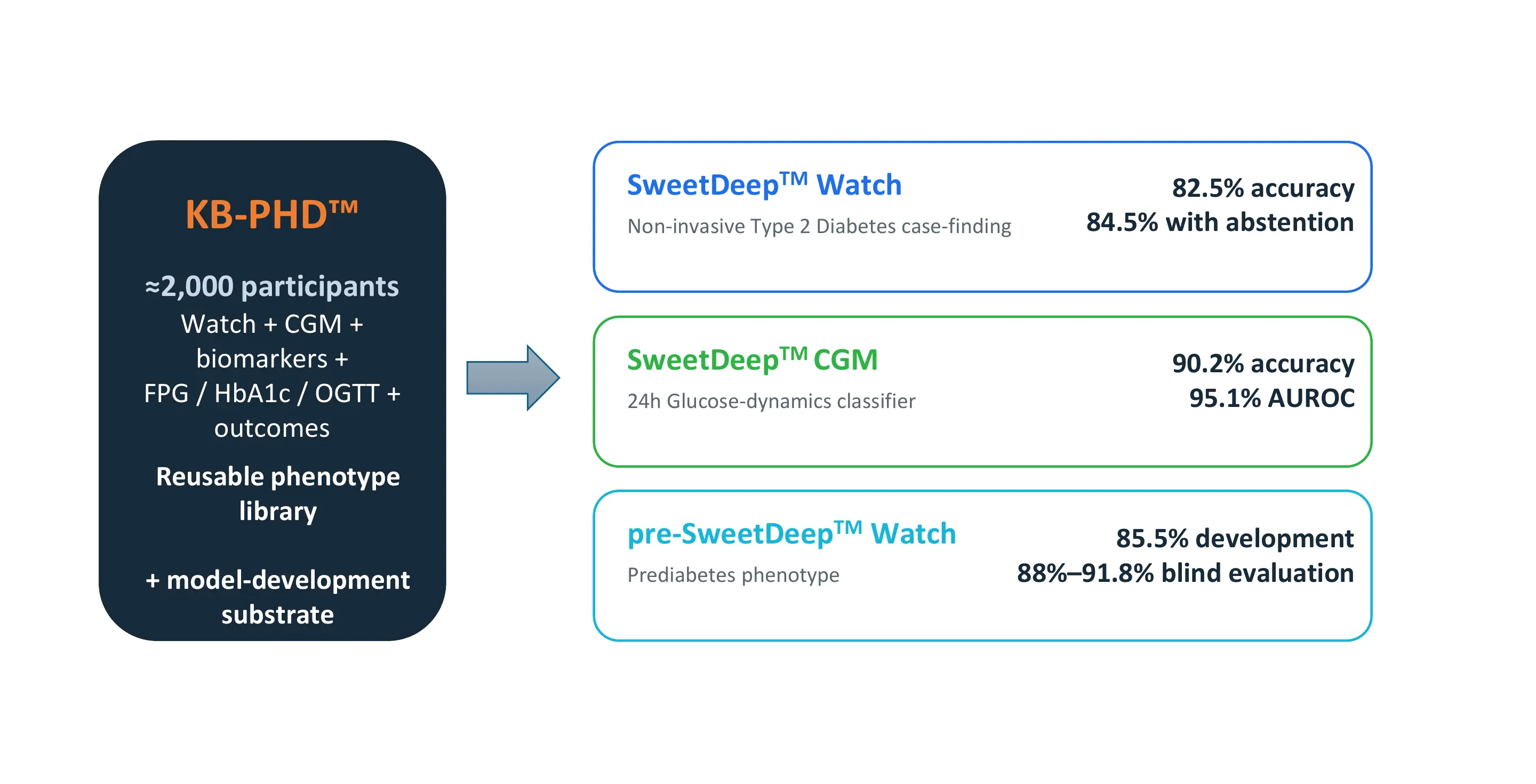
Three related bodies of evidence, three different questions.
The studies build on one another, but they should not be combined into a single product-performance claim.
PRE-SWEETDEEP FOUNDATION
Build the knowledge base.
Earlier clinical and engineering work established linked physiology, metabolic reference data, signal-processing methods and disease phenotypes.
SWEETDEEP-CGM RESEARCH
Understand metabolic dynamics.
CGM and linked clinical measures help study temporal glucose patterns and provide research context for wearable model development.
SWEETDEEP WATCH RESEARCH
Evaluate wearable-only signals.
Investigational models test whether compatible smartwatch signals can identify useful cardiometabolic patterns against defined reference data.
Supporting detail: Study protocol
Supporting detail: Clinical validation
Supporting detail: Standard-of-care comparison
Supporting detail: SweetDeep publication
Supporting detail: MFDeep program
CLAIM AND REGULATORY BOUNDARY
One evidence base, two separately governed paths.
Research findings can inform product development. They do not automatically become consumer claims.
SweetDeep consumer experience
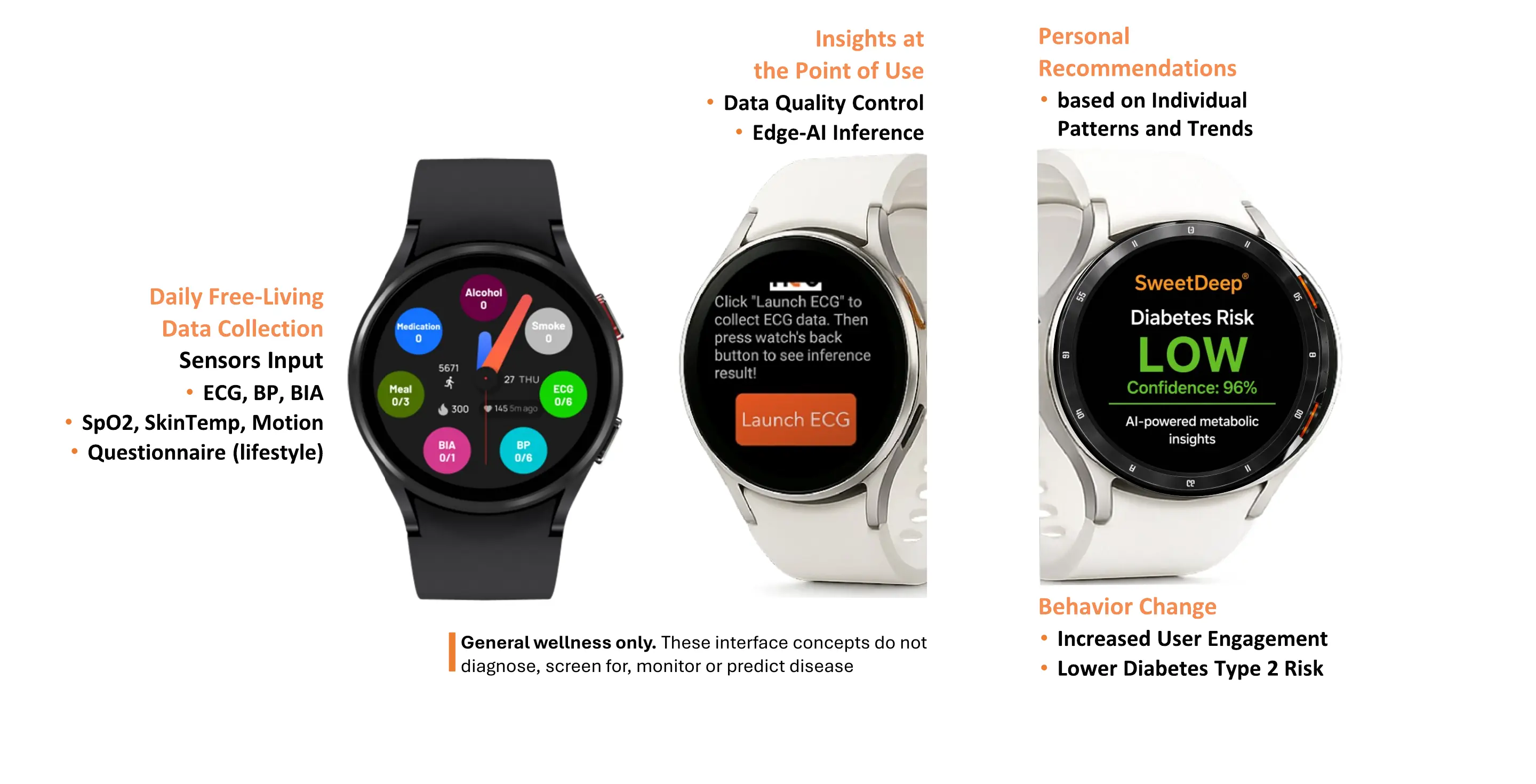
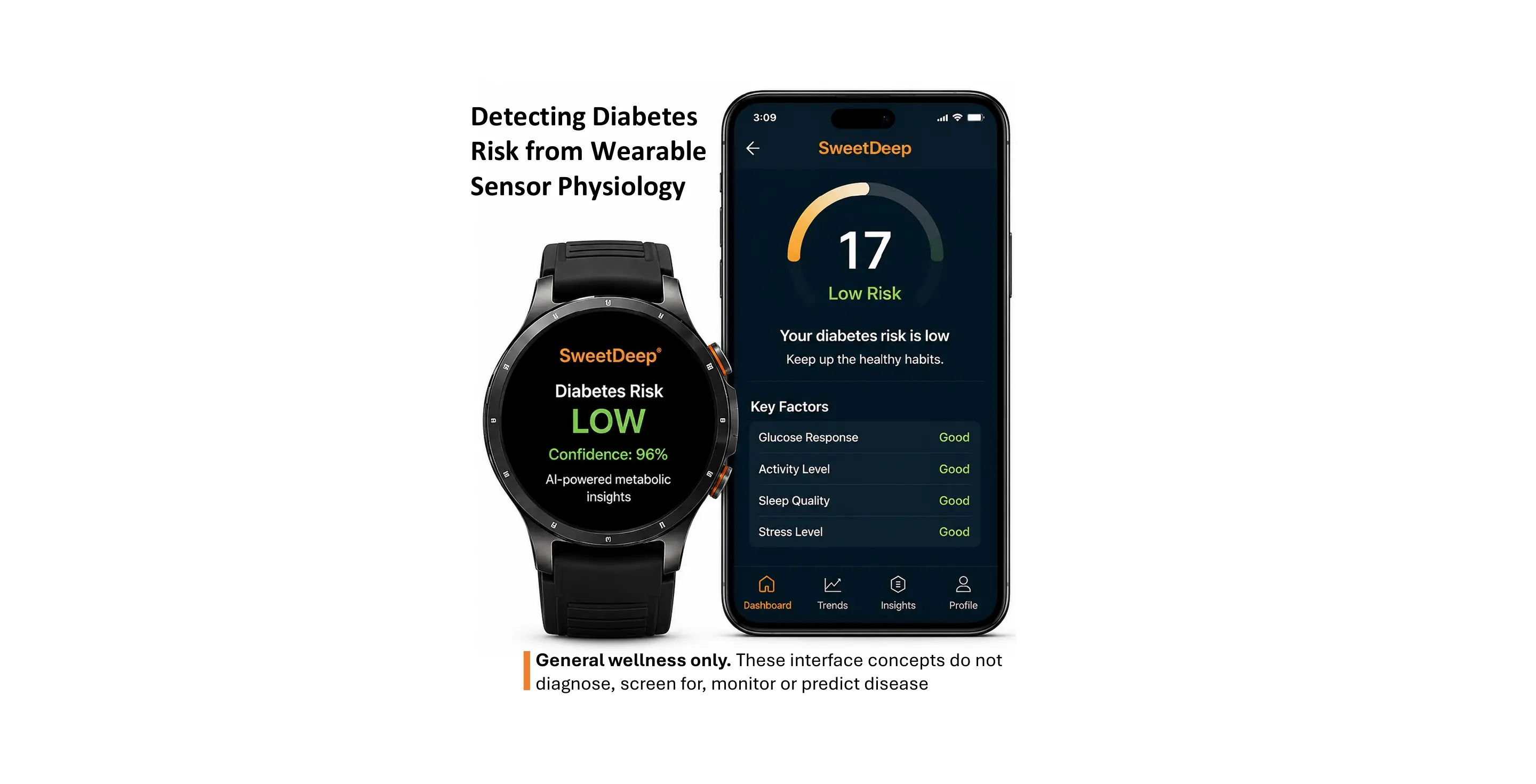
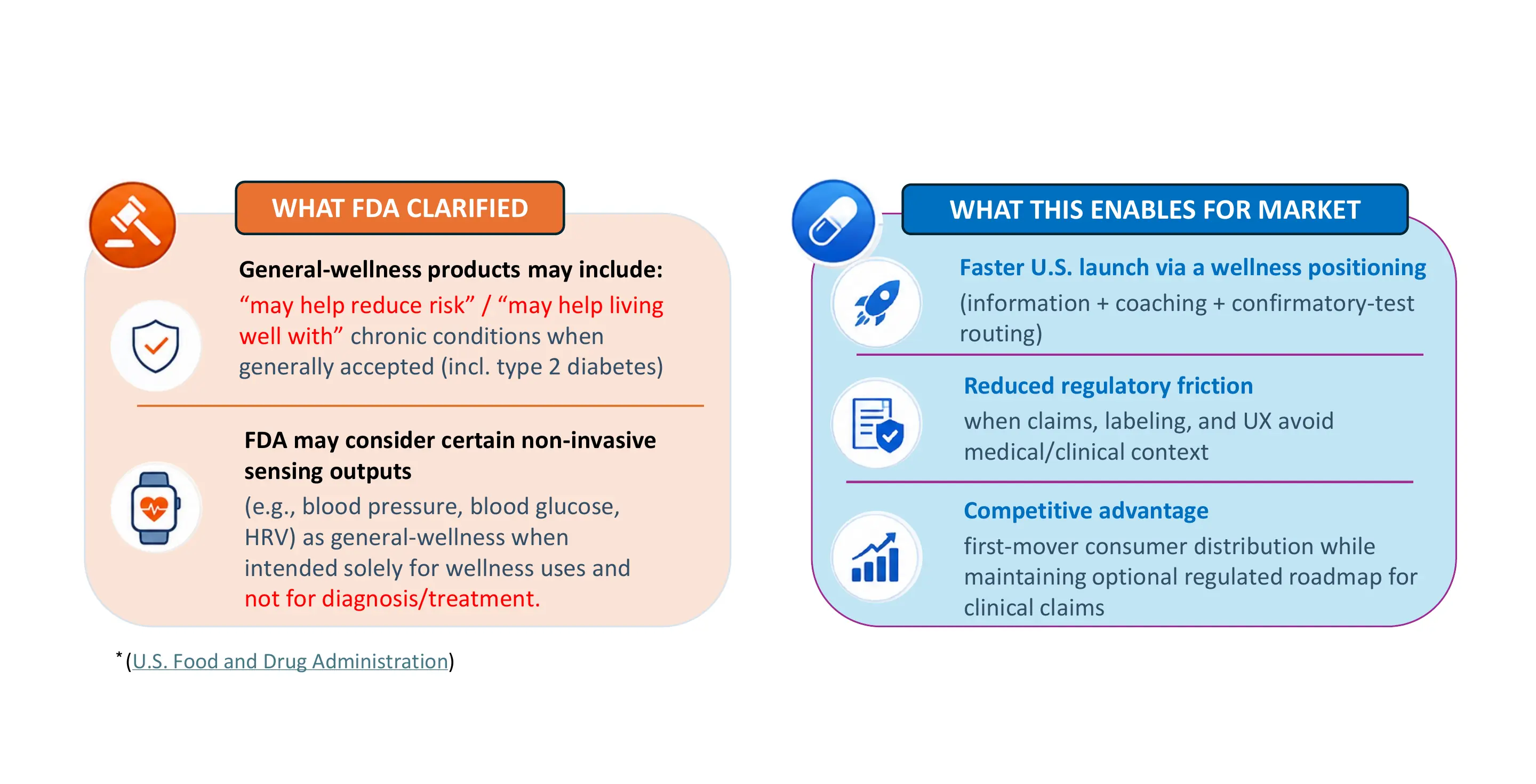
Metabolic-wellness patterns, personal trends, wellness education and healthy-habit support. It does not diagnose, measure glucose, screen for disease or provide a medical recommendation.
FDA general-wellness guidance ↗Diabetes-risk model research
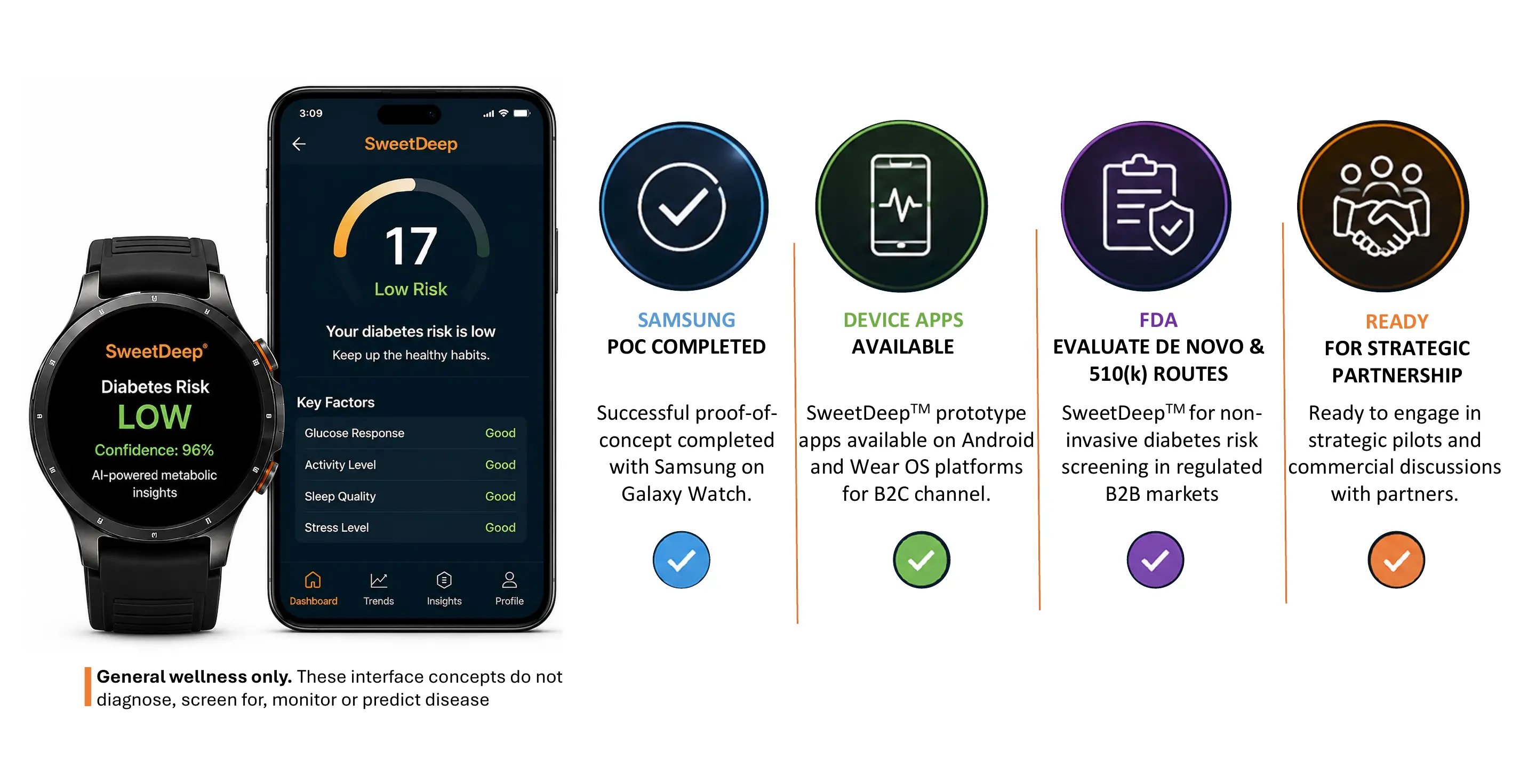
Research evaluates non-invasive risk-identification and triage questions. A Breakthrough Device Designation application was submitted for an investigational concept; submission is not designation, clearance or approval.
FDA Breakthrough Devices Program ↗Supporting detail: Investigational healthcare experience
Supporting detail: Investigational watch and phone apps
Supporting detail: Healthcare development status
Supporting detail: General-wellness guidance
DEFENSIBLE TECHNOLOGY
The evidence compounds with the IP.
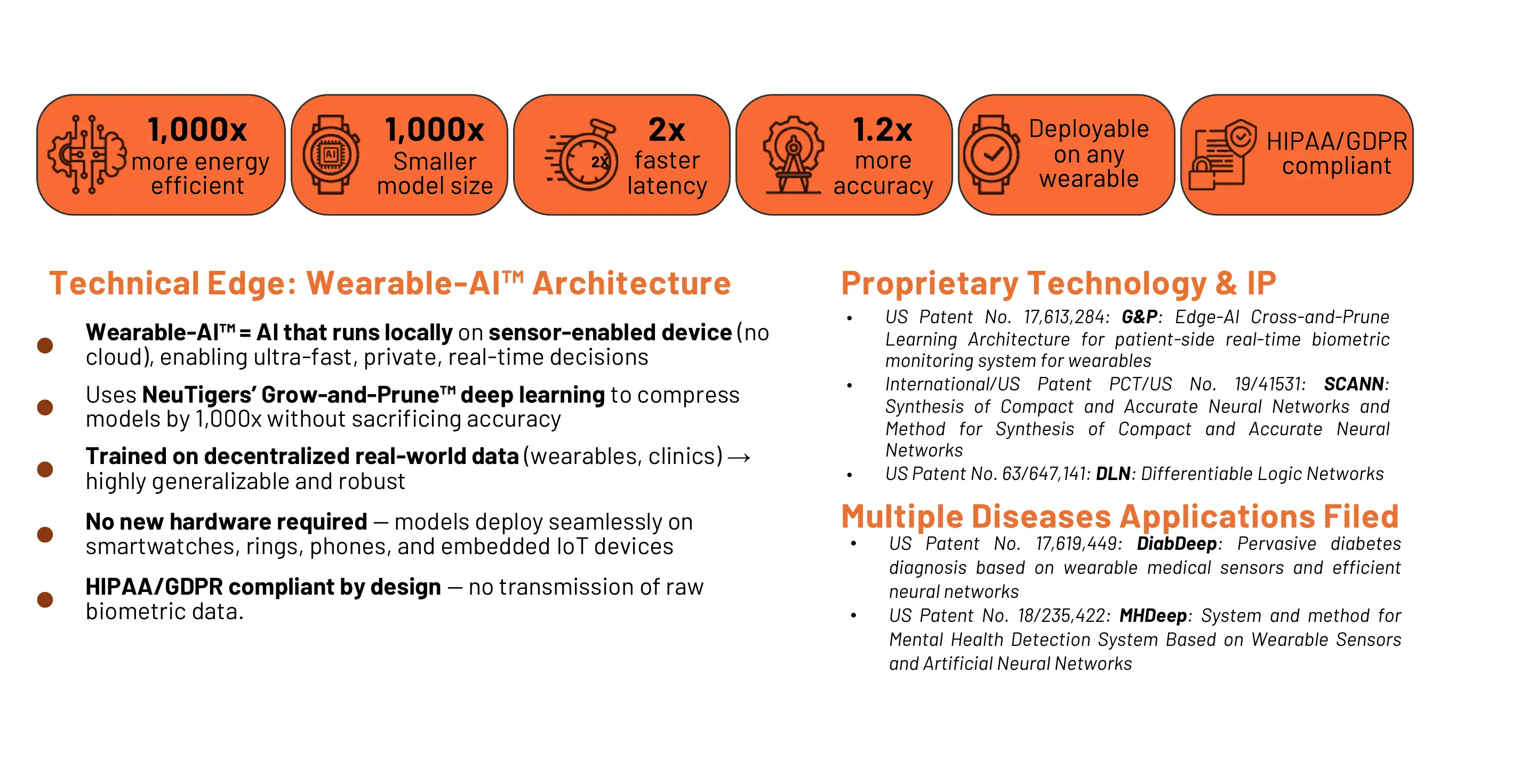
NeuTigers combines proprietary and licensed Edge-AI IP, participant-linked data assets, application know-how and integration experience. Specific IP records are identified by issued or pending status during qualified diligence.
EDGE-AI IP
Compact model architectures
Designed for resource-constrained wearable and mobile environments.
DATA ASSET
Linked cardiometabolic evidence
Multimodal participant histories that support model development and evaluation.
TRANSLATION KNOW-HOW
From study to device
Signal science, application development, validation and partner integration in one workflow.
Supporting detail: Edge-AI and intellectual property
Supporting detail: Market positioning
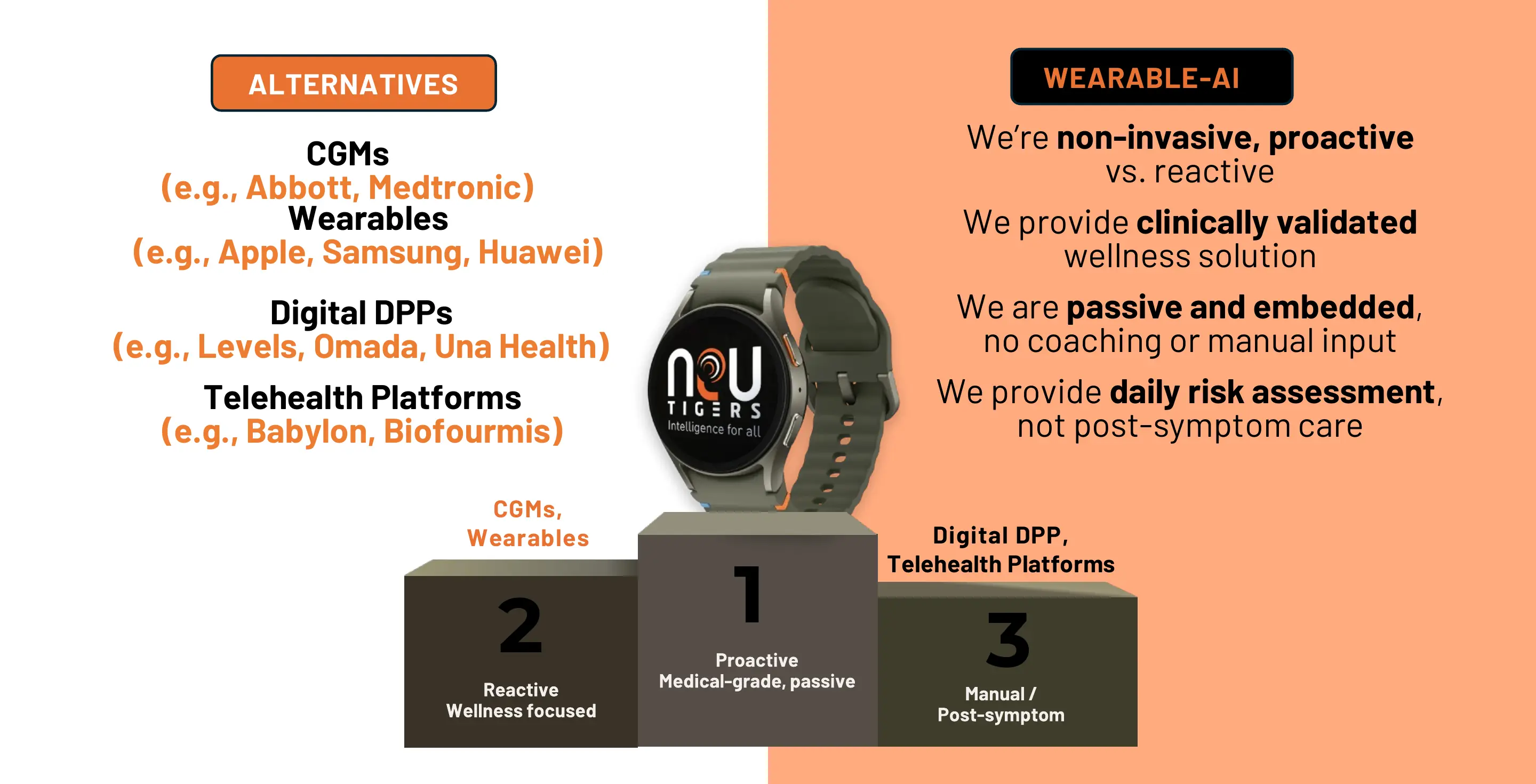
Supporting detail: Competitive differentiation
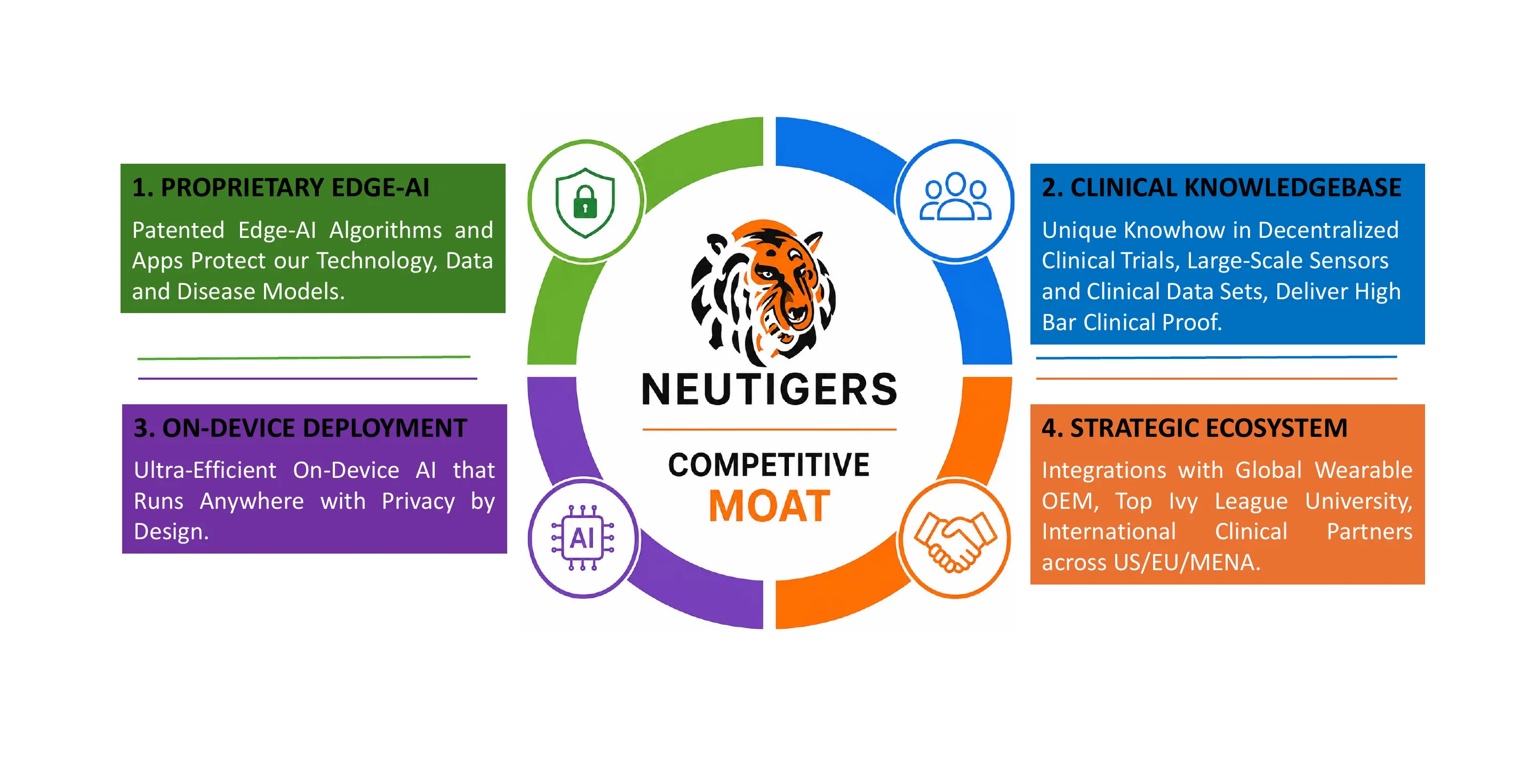
SOURCES + METHODOLOGY
Open the level of detail needed for diligence.
Public evidence is distinguished from company portfolio records. No market-size or user-growth projections are used on this website.
Public SweetDeep preprint +
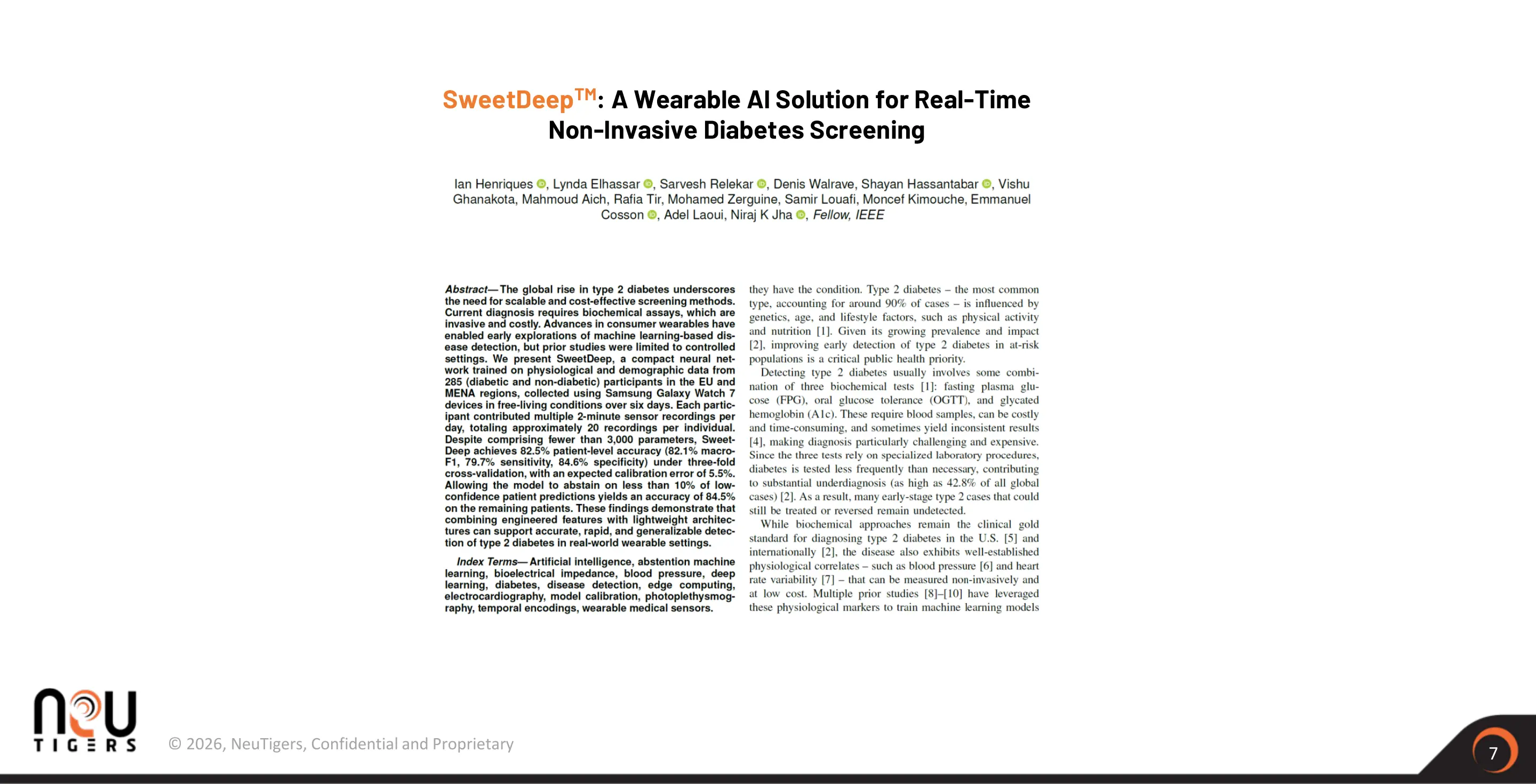
Identifier: arXiv:2512.03471. Analysis set: 285 participants. Reported result: 82.5% patient-level accuracy, increasing to 84.5% after abstention on low-confidence predictions. Review the paper for study design, population, validation and limitations.
Open source ↗NeuTigers research portfolio +
The approximately 2,000-participant and four-study figures summarize NeuTigers company research records across completed and initiated programs in the U.S., Europe and MENA as of August 2026. Protocol-level details are available through qualified diligence.
Samsung implementation evidence +
A Galaxy Watch proof of concept was completed and applications are working in Wear OS and Android environments. This demonstrates implementation readiness; it is not presented as recurring licensing revenue or broad commercial deployment.
General-wellness policy reference +
The planned SweetDeep consumer experience is positioned for general wellness. The FDA policy is a regulatory reference and does not mean FDA has reviewed, cleared or approved SweetDeep.
Open FDA guidance ↗RESEARCH FAQ
Questions the evidence answers.
Direct answers drawn from the studies on this page. Investigational research; not a cleared medical device.
How accurate is smartwatch-based diabetes risk screening in studies?
+
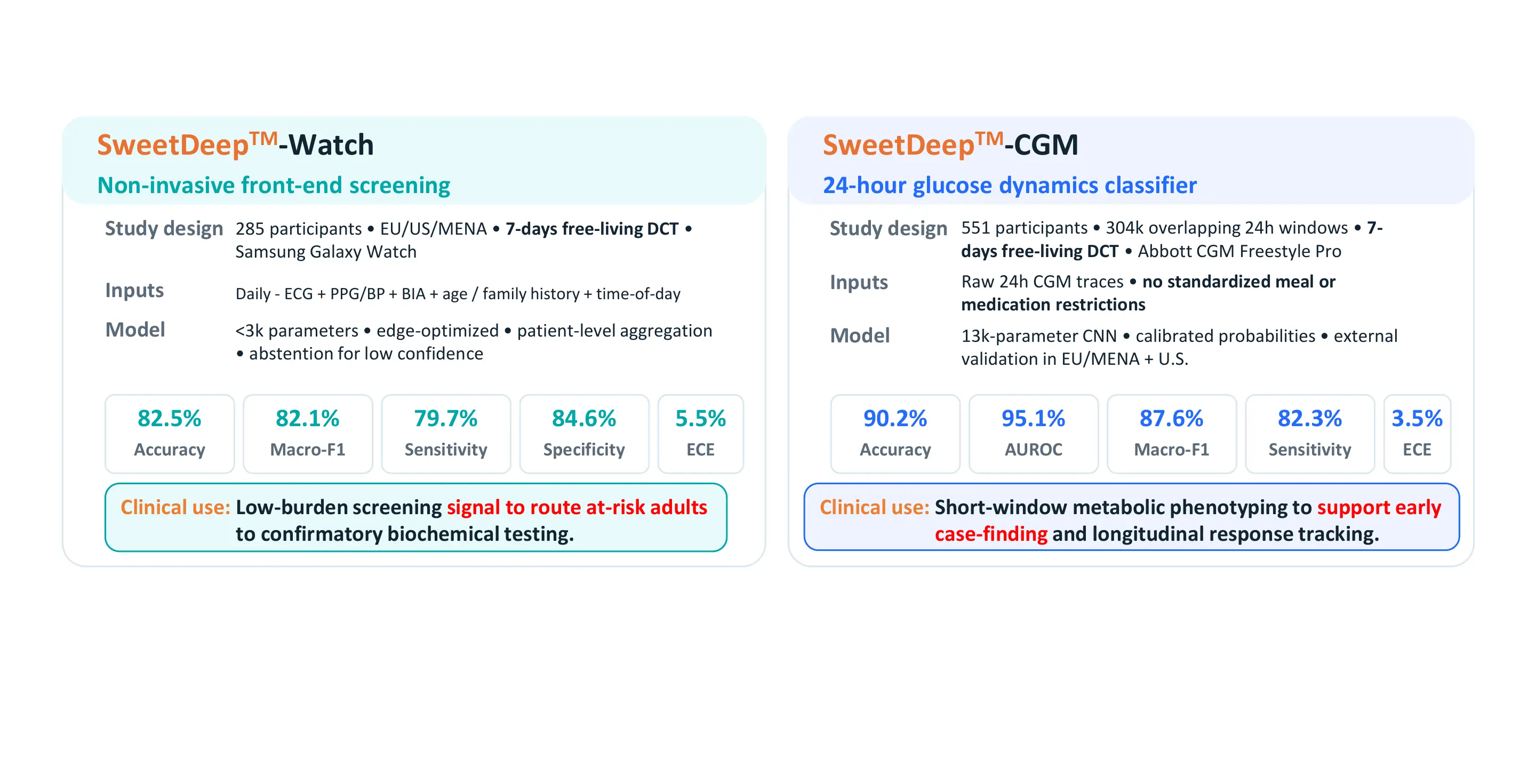
In NeuTigers’ prospective SweetDeep-Watch study arm (285 participants across the EU, US and MENA, seven days of free-living data on Samsung Galaxy Watch), the investigational model reached 82.5% patient-level accuracy against biochemical ground truth, with 82.1% macro-F1, 79.7% sensitivity, 84.6% specificity and a 5.5% expected calibration error. Allowing the model to abstain on fewer than 10% of low-confidence cases raised accuracy to 84.5%. This is investigational research, not a cleared medical device.
How does wearable-AI screening compare with the FINDRISC questionnaire?
+
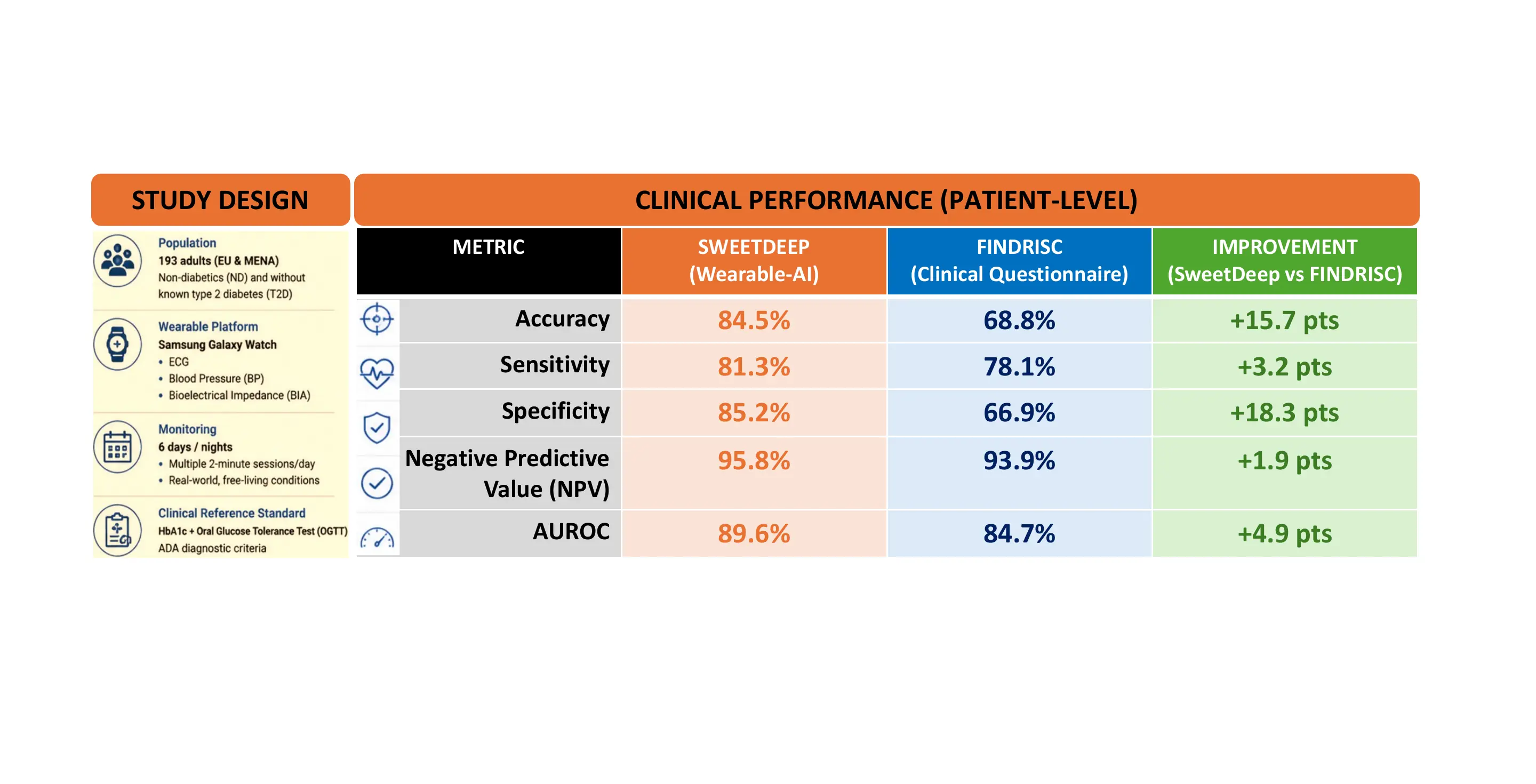
In a patient-level comparison on the same population, the investigational SweetDeep-Watch model outperformed the standard FINDRISC questionnaire on every reported metric: accuracy 84.5% vs 68.8% (+15.7 points), specificity 85.2% vs 66.9% (+18.3 points), sensitivity 81.3% vs 78.1% (+3.2 points), negative predictive value 95.8% vs 93.9%, and AUROC 89.6% vs 84.7%.
Can CGM data alone signal type 2 diabetes risk?
+
In NeuTigers’ SweetDeep-CGM study arm, a 13,000-parameter convolutional neural network trained on raw 24-hour CGM traces from 551 participants (304,000 overlapping windows, no standardized meal or medication restrictions) classified type 2 diabetes vs non-diabetes with 90.2% accuracy, 95.1% AUROC, 87.6% macro-F1 and a 3.5% calibration error, with external validation across France + Algeria and United States cohorts. Investigational research.
What signals does the wearable model use?
+
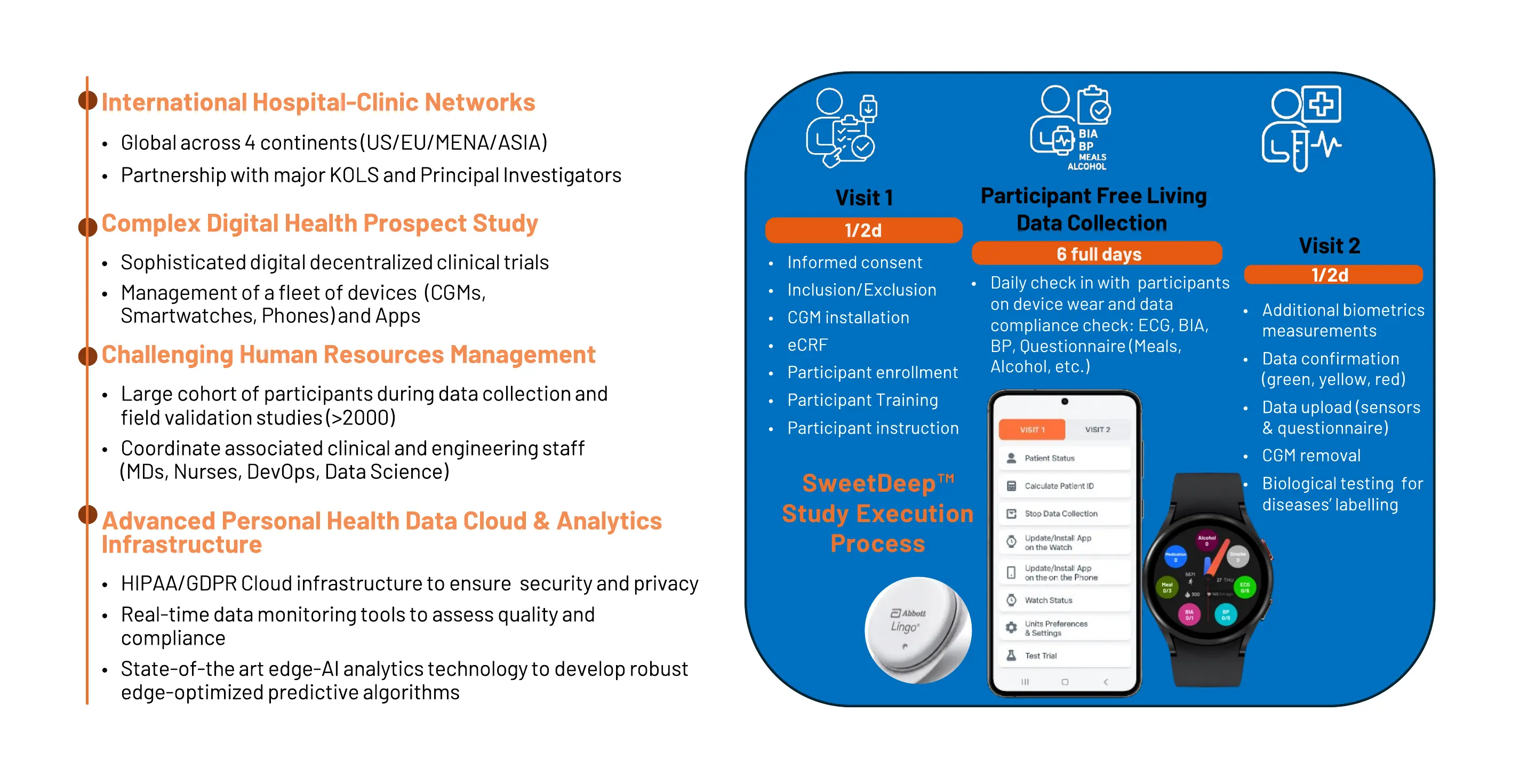
Daily two-minute recordings of ECG, PPG/blood pressure and bioelectrical impedance (BIA), combined with age, family history and time-of-day. The model has fewer than 3,000 parameters, runs on-device (Edge-AI), aggregates predictions at patient level and abstains when confidence is low.
Is SweetDeep FDA cleared?
+
No. The planned initial consumer experience is positioned as general wellness, which FDA does not review, and it is not intended to diagnose, treat, cure or prevent disease. The screening capability described on this page is investigational; NeuTigers is evaluating De Novo and 510(k) routes for regulated B2B uses.
What is the KB-PCMHD cardiometabolic knowledge base?
+
A research knowledge base of roughly 2,000 study participants across the US, EU and MENA that links, at participant level, watch-sensor physiology, CGM glucose dynamics, cardiometabolic biomarkers, biochemical reference tests (FPG, HbA1c, OGTT) and outcomes. It serves as the substrate for developing and validating new models.
Where is the research published?
+
The SweetDeep study, “SweetDeep: A Wearable AI Solution for Real-Time Non-Invasive Diabetes Screening”, is available as a preprint on arXiv (2512.03471).
QUALIFIED DILIGENCE